Replenishment automation that understands service risk and cost
Most service parts organizations already “automate” replenishment.
Yet planners still review and override orders every day. That’s not a change-management problem. It’s a design problem.
Cloud Neato Replenishment uses a decision layer to automate service parts replenishment by economically balancing service risk against transportation and trade-compliance cost — the same judgment experienced planners apply manually today.
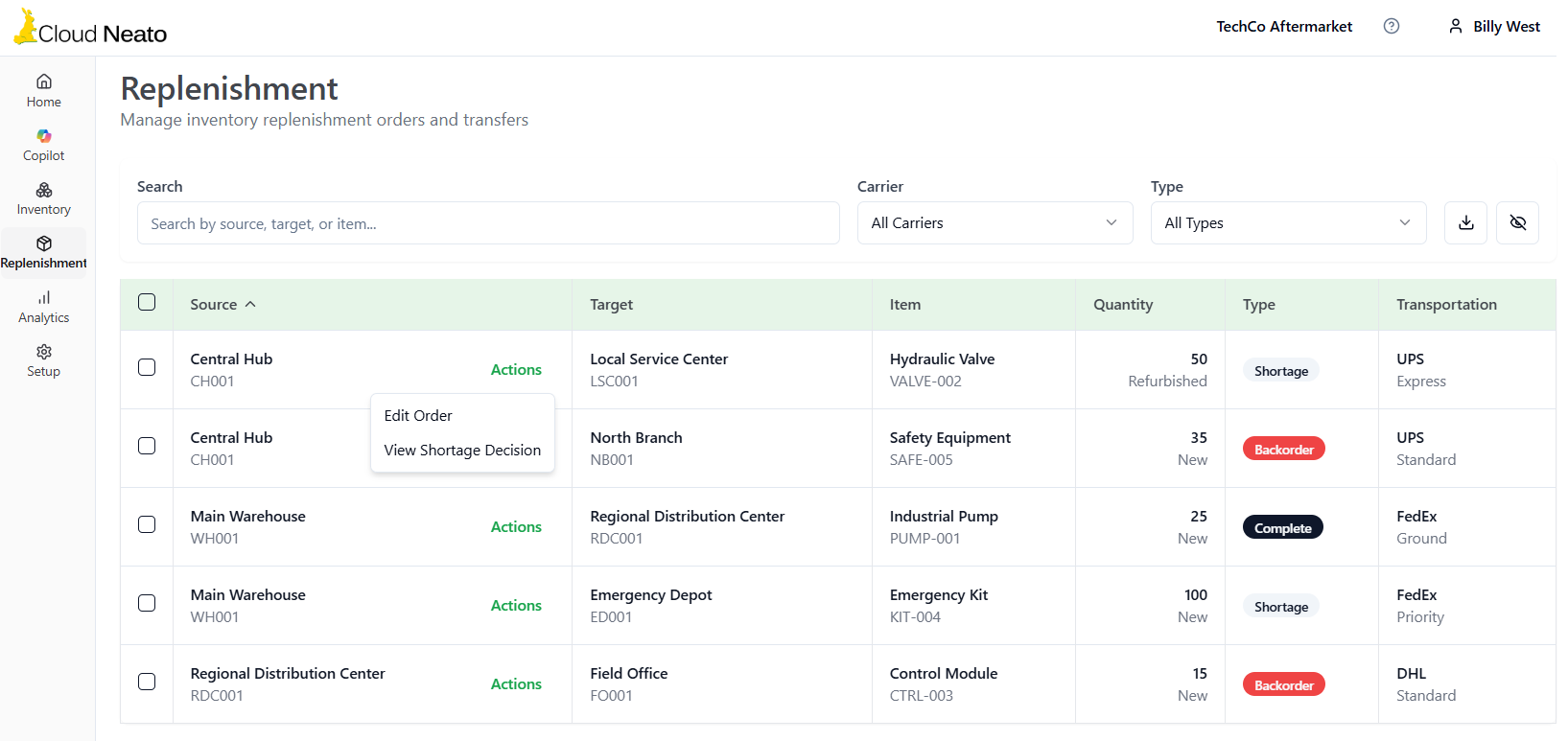
Why replenishment automation breaks in service parts
Traditional replenishment automation is built on a simple assumption:
If inventory falls below a target, place an order.
That logic works in high-volume, low-variability environments.
It breaks down in service parts, where:
- Inventory targets are often one unit
- Demand is uncertain and intermittent
- Replenishment frequently crosses borders
- Shipping a single part can trigger disproportionate freight and customs cost
The result is predictable:
- Excessive single-item shipments
- High expedite and transportation spend
- Trade-compliance friction
- And planners who stop trusting the system
How experienced planners really make replenishment decisions
Great planners are not asking:
“Is inventory below target?”
They are asking:
“Should I ship now — or can I safely wait?”
That single question implicitly balances:
- Risk of service disruption
- Time to recover if service is interrupted
- Cost of shipping now versus later
- Customs minimums and compliance fees
Traditional systems cannot answer this question — so planners do it manually.
Prioritization alone is not enough
Some legacy service planning tools attempt to prioritize shortages.
That helps — but it stops short.
They rank urgency, then still trigger replenishment based on static rules. They do not use that urgency to actively trade off against:
- Shipment consolidation opportunities
-
Customs and trade-compliance minimums
A better model: price the decision
Cloud Neato introduces an explicit decision layer between planning and execution.
Instead of asking “Should we replenish?”, it asks:
“What is the expected cost of waiting one more day — and is that greater than the cost of shipping now?”
To answer that, Cloud Neato calculates Service Risk, based on three dimensions:
-
Likelihood
How likely a stockout is before replenishment arrives -
Recovery Time
How long it would take to restore service if demand cannot be met -
Severity
How critical the part and site are to service outcomes
This converts service uncertainty into an expected business cost — not a binary stockout flag.
Replenishment decisions you can explain — and trust
Because service risk is expressed economically, Cloud Neato can explain decisions clearly:
“Waiting one more day increases expected service risk by $420.”
“Shipping now avoids that risk, but costs $310 in freight and customs.”
This allows the system to automate judgement, not just execution, to confidently:
- Wait for consolidation when risk is low
- Avoid low-value cross-border shipments
- Act immediately when service risk truly dominates cost
Every recommendation is transparent and aligned with how planners already think.
What this unlocks for service organizations
- Fewer single-item shipments — without degrading service
- Lower transportation and customs spend
- Higher planner trust and adoption
- Automation that delegates judgment without abdicating control
This is not about replacing planners. It’s about giving automation the same economic judgment that experienced planners apply manually today.
30-day, no risk evaluation
Cloud Neato Replenishment integrates with your service logistics partner, eliminating dependency on internal IT teams for deployment.
In a short evaluation, we quantify:
- How many replenishment decisions could have waited safely
- Where consolidation opportunities were missed
- How service risk would have changed
- The potential transportation and trade-compliance savings
No black boxes. No excel based value assumptions.
Just your data, analyzed through a decision model built for service-parts reality.